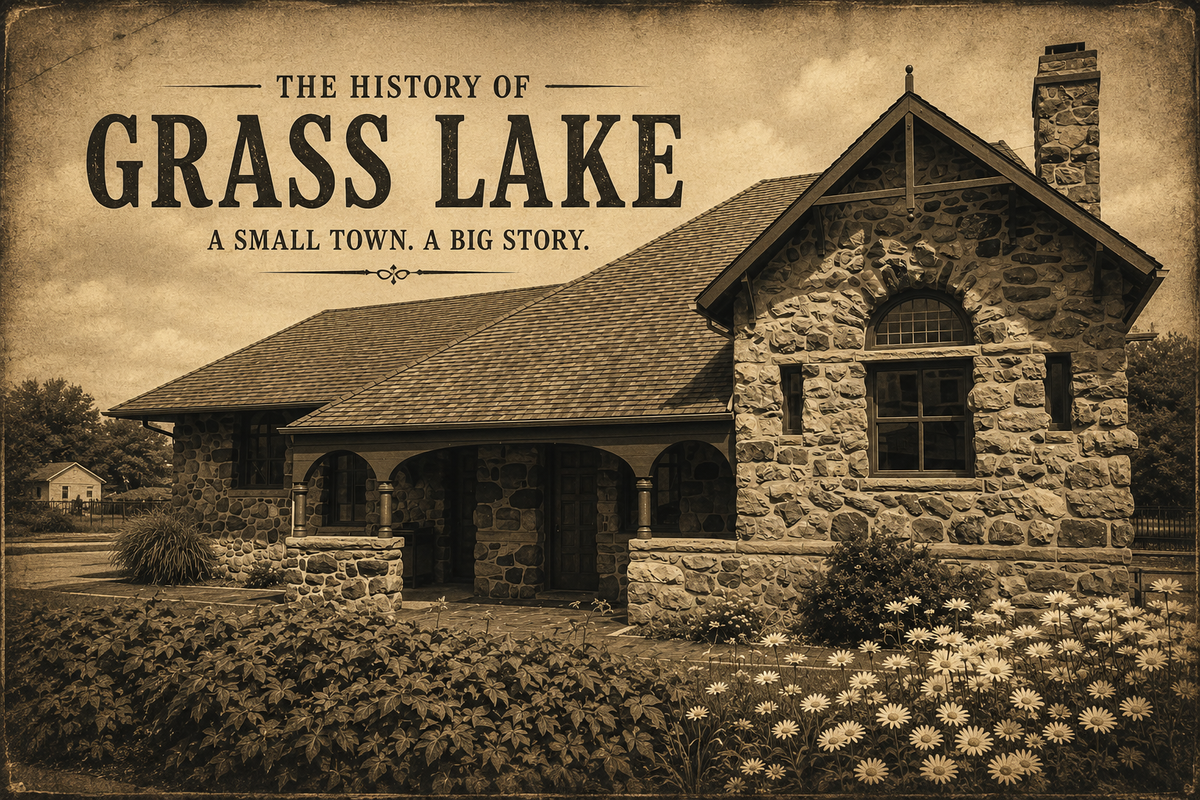
There are towns in Michigan that feel like they appeared all at once — planned, paved, and fully formed.
Grass Lake is not one of them.
The village grew in pieces. Some of it happened intentionally. Some of it happened because of timing, transportation, and a railroad company making decisions that local residents couldn’t control. And like a lot of small Midwestern towns, Grass Lake’s history isn’t really a straight line. It’s a story about adaptation.
Today, people mostly know Grass Lake as a quiet village in eastern Jackson County — a place with Friday night football, lake life, small businesses, and a downtown that still feels recognizably local. But the version of Grass Lake people see now exists because the town repeatedly changed course over nearly two centuries.
Long before there were storefronts along Michigan Avenue, the area around Grass Lake was marshy and heavily wooded. The lake itself was surrounded by tall grasses and wetlands, which eventually gave the community its name. Native American tribes, including the Potawatomi, traveled through and lived throughout the region before permanent settlement by Europeans and Americans.[1]
The first settlers arrived in the late 1820s, when Michigan was still a territory and much of southern Michigan remained sparsely developed. Like many early settlements, Grass Lake started with farms, rough roads, and basic trading activity. Families built homes near water sources and transportation routes, and over time a small settlement formed.[1:1]
But the original center of town was not where downtown Grass Lake sits today.
Early development was concentrated farther east, in an area historically referred to as Grass Lake Center. For a while, residents assumed that would become the permanent location of the village. Businesses and homes began forming there, and the community slowly grew.
Then the railroad arrived.
Or more accurately, it arrived nearby.
In the 1840s, the Michigan Central Railroad expanded west across the state, connecting Detroit toward Chicago. At the time, railroad access could completely reshape a town’s future. Communities with stations grew quickly. Communities bypassed by rail lines often struggled.[2]
Grass Lake residents wanted the railroad to pass directly through the original village center. Historical accounts suggest disagreements over land costs and route placement led railroad officials to build the depot farther west instead.[3]
That decision changed everything.
Businesses began shifting toward the depot almost immediately. Stores, hotels, churches, and gathering spaces slowly migrated closer to the rail traffic. Some buildings were reportedly moved physically. Others were abandoned as the new center of economic activity developed near the tracks.[3:1]
In a very real sense, Grass Lake relocated itself.
The modern downtown that exists today formed because the railroad redirected the town’s energy westward.
By the second half of the nineteenth century, Grass Lake had become firmly connected to Michigan’s growing transportation network. Farmers could move livestock and crops more efficiently. Goods arrived faster. Travel became easier. The railroad turned what had once been an isolated settlement into a connected small town.[2:1]
The village officially incorporated in 1871.
Not long after, Grass Lake received the depot that still defines much of the town’s historic identity today.
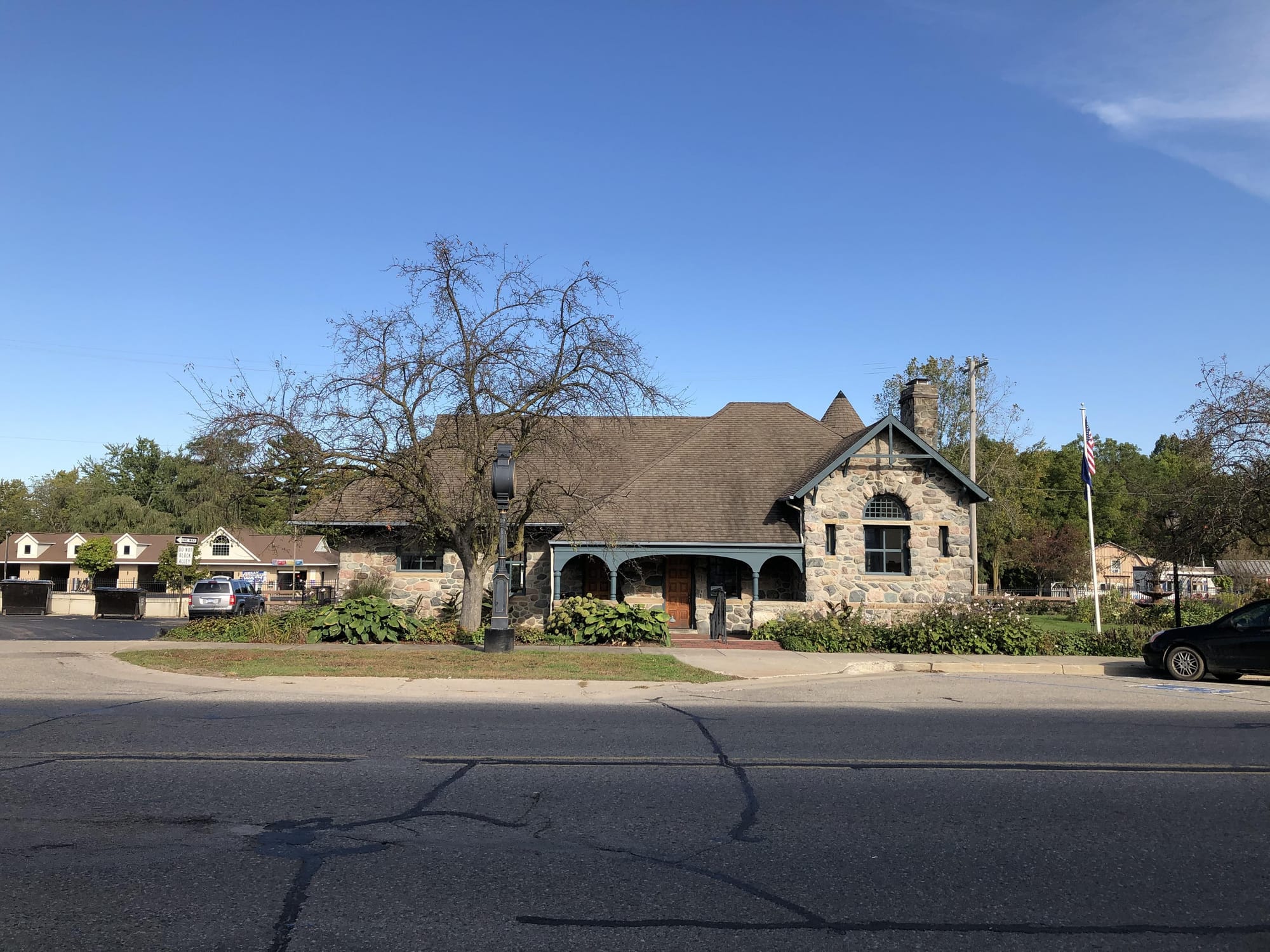
The current stone depot was completed in 1887 and designed in the Richardsonian Romanesque architectural style, which was popular for major public and railroad buildings during that era.[4]
For a town the size of Grass Lake, the station was surprisingly ambitious.
The depot reflected confidence — not just in the railroad industry, but in the future of the village itself. Trains were central to everyday life. Passenger trains moved people through town constantly, and freight traffic connected local farms and businesses to larger regional markets.
At its peak, the railroad shaped the rhythm of daily life in Grass Lake.
People measured time around train schedules. Visitors arrived through the depot. Commerce moved through the tracks. The sound of locomotives was part of the background of the town.
And rail transportation in Grass Lake didn’t stop with traditional steam trains.
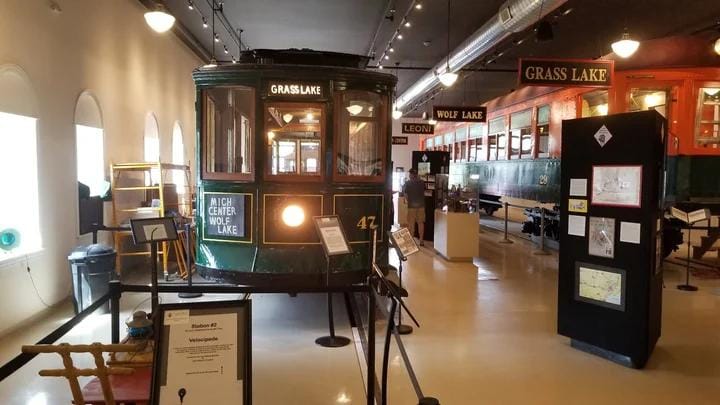
The village also became tied into Michigan’s interurban railway era — electric rail systems that connected smaller communities throughout the region before widespread automobile ownership changed transportation forever.[5]
That part of the town’s history is still preserved today through the Lost Railway Museum downtown.
Like many railroad towns across the Midwest, Grass Lake eventually had to adjust to a changing world.
As automobiles became more common in the early and middle twentieth century, passenger rail traffic declined sharply. Highways replaced train lines as the primary way people traveled between towns.[6]
By the 1950s, passenger service through Grass Lake had slowed dramatically.
Eventually, regular passenger rail service ended altogether.
The depot that had once shaped the entire community suddenly had no real purpose.
For years, the building sat in various states of decline. It was used for other purposes for a time, including newspaper operations, but maintaining an aging railroad structure became increasingly difficult.
Then came the fire.
In 1980, a major fire heavily damaged the depot, leaving much of the structure gutted. For many small towns, that probably would have marked the end of the building.[6:1]
Instead, residents stepped in.
Community groups organized restoration efforts, fundraising, and preservation work to save the depot from disappearing completely. By the late 1980s and early 1990s, restoration projects helped return the building and surrounding park area to usable condition.[6:2]
Today, the depot still stands not because it remained economically useful, but because people in Grass Lake decided it mattered.
That distinction says a lot about the town.
Grass Lake’s history is tied to transportation, but its identity has always been shaped by community involvement.
The town has repeatedly relied on local organizations, volunteers, school systems, churches, and small businesses to maintain the kinds of spaces that larger cities often take for granted.
That includes everything from preserving the depot to supporting athletics, maintaining parks, organizing festivals, and rebuilding downtown businesses over time.
Even now, much of Grass Lake still operates through relationships.
People know the owners of businesses downtown. Kids grow up playing sports together across multiple age groups. School events become community events. Local Facebook pages move information faster than official announcements half the time.[7]
That small-town structure can be messy sometimes, but it also creates continuity.
Many families who live in Grass Lake today have parents or grandparents who attended the same schools, used the same parks, or worked in the same general area decades earlier.
And while the village has changed significantly over time, parts of older Grass Lake still remain visible.
The lake is still there.
The railroad tracks still cut through town.
The depot still anchors downtown.
Even the street layout reflects decisions made more than a century ago.
Modern Grass Lake exists somewhere between a traditional small town and a commuter community.[8]
Some residents work locally. Others drive daily toward Jackson, Ann Arbor, or Lansing. New families continue moving into the area because of the schools, location, and slower pace compared to larger nearby cities.
At the same time, the village still retains parts of its earlier identity.
Downtown remains compact and walkable.
Community events still matter.
Local sports still draw crowds.
And despite changes in transportation, technology, and population, Grass Lake still feels connected to its own history in a way many towns no longer do.
That history isn’t always dramatic.
Most of it is quieter than that.
It’s in the buildings that survived.
The parks people continue using.
The schools that expanded as the town grew.
The old depot that once moved an entire downtown westward.
Grass Lake didn’t become what it is through a single defining moment.
It became Grass Lake gradually — through movement, adaptation, and the decisions of generations of people who kept choosing to invest in a small town that could have easily disappeared into history like so many others.
Sources
Historic Depot Photos
Historical Marker Database (HMDB)
https://www.hmdb.org/m.asp?m=55223
Lost Railway Museum Images
Lost Railway Museum
https://www.lostrailwaymuseum.org/
Jackson County historical materials and Grass Lake Area Historical Society records regarding early settlement and Native American history. ↩︎ ↩︎
Michigan Central Railroad historical archives and regional transportation history resources. ↩︎ ↩︎
Historical summaries regarding the relocation of the village center toward the railroad depot. ↩︎ ↩︎
Historical Marker Database (HMDB.org) documentation on the 1887 Grass Lake Depot and its architecture. ↩︎
Lost Railway Museum historical information and Michigan interurban railway references (https://www.lostrailwaymuseum.org/). ↩︎
Local preservation records and depot restoration history materials. ↩︎ ↩︎ ↩︎
Contemporary observations based on present-day community life and local institutions in Grass Lake, Michigan (https://www.villageofgrasslake.com/). ↩︎
U.S. Census data and regional Jackson County demographic trends. ↩︎